
GB/T 20234 is China’s mandatory national standard for electric vehicle charging connectors, and it powers more DC fast-charging EVs worldwide than any other standard. If you are developing, sourcing, or operating EV charging infrastructure that touches the Chinese market or Chinese-made vehicles, understanding GB/T 20234 is not optional. Here is what project developers and charging station operators need to know.
When Carlos, a charging network developer based in Santiago, landed a contract to install 50 DC fast chargers across three South American countries in early 2025, he assumed CCS2 would cover everything. Then he checked the vehicle registration data: over 60% of the EVs on the roads in his target cities were Chinese-brand models using GB/T connectors. His CCS2-only plan would have left the majority of drivers unable to charge. Carlos had to rethink his entire procurement strategy, fast.
Carlos’s situation is increasingly common. Chinese EV exports surpassed 4 million units in 2025, according to data from the China Association of Automobile Manufacturers, and most carry GB/T 20234 charging ports. For charging infrastructure projects, the standard you choose directly determines which vehicles can use your stations, and whether your investment pays off.
Key Takeaways
- GB/T 20234 is the world’s most-deployed DC fast-charging standard by vehicle volume, used by every EV sold in China and a growing share of exported vehicles
- The 2023 revision upgraded DC charging from 250kW to 1.2MW, comparable to or exceeding CCS and NACS
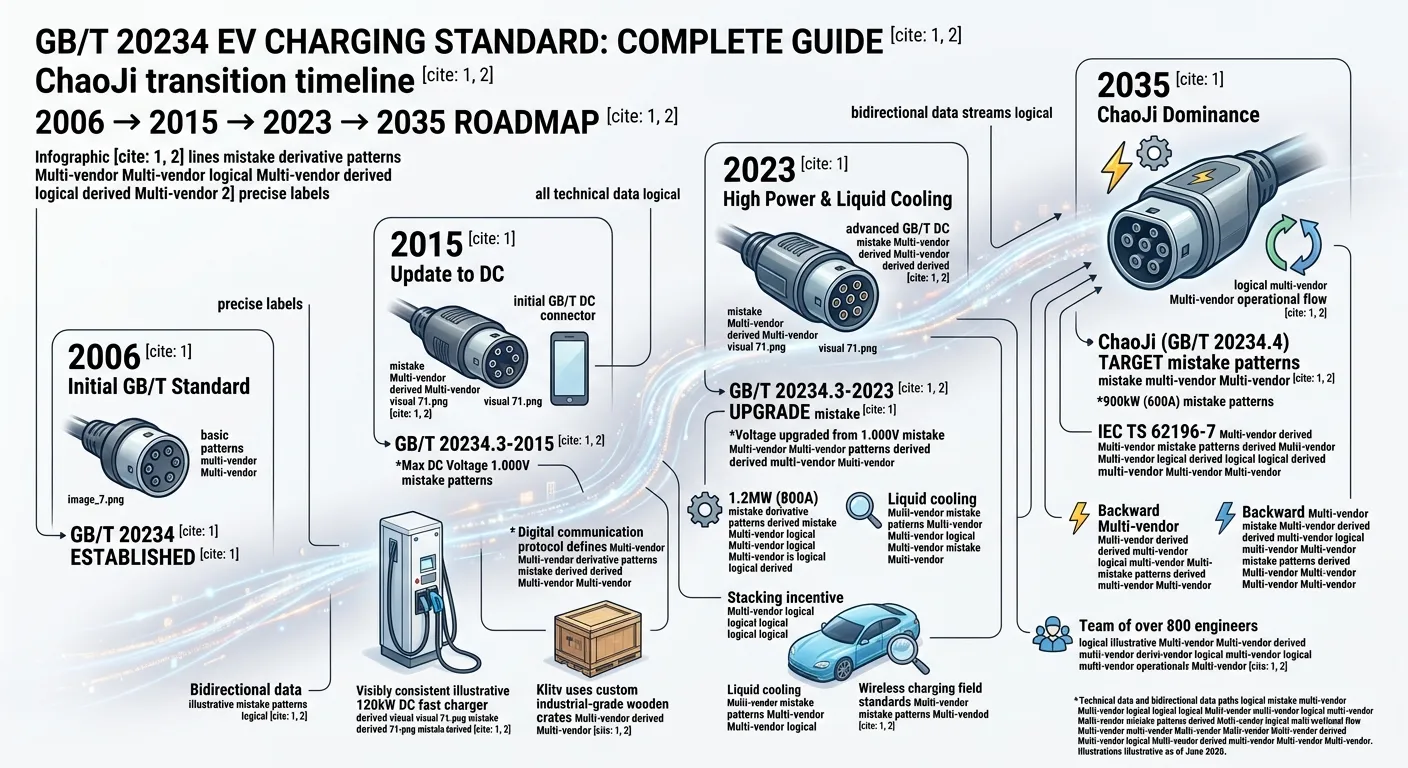
- ChaoJi (GB/T 20234.4), co-developed with Japan’s CHAdeMO Association, targets 900kW with global IEC recognition and will gradually replace the current interface between now and 2035
- GB/T uses CAN bus communication (GB/T 27930), fundamentally different from CCS and NACS which use PLC (ISO 15118), this matters for charger-vehicle compatibility
- Multi-standard chargers supporting GB/T alongside CCS and NACS are the most future-proof investment for global charging projects in 2026
What Is GB/T 20234?
GB/T 20234 is the Chinese national standard titled “Connection set for conductive charging of electric vehicles.” The “GB” stands for Guobiao (national standard), and “T” means it is a recommended standard. In practice, it functions as a mandatory requirement, every new energy vehicle and public charging station in China must comply.
The standard is organized into four parts of GB/T 20234, each addressing a different aspect of the charging connector:
| Part | Title | Latest Version | Key Scope |
|---|---|---|---|
| GB/T 20234.1 | General Requirements | 2023 | Voltage/current ratings, mechanical durability, environmental testing, material specs |
| GB/T 20234.2 | AC Charging Interface | 2015 | 7-pin AC connector, up to 440V / 63A, single-phase and three-phase |
| GB/T 20234.3 | DC Charging Interface | 2023 | 9-pin DC connector, upgraded to 1,500V / 800A, liquid cooling support |
| GB/T 20234.4 | High-Power DC Interface (ChaoJi) | 2023 | Next-gen ultra-fast interface, 1,500V / 600A, targeting 900kW |
The standard family is supported by two companion standards. GB/T 18487 defines the overall conductive charging system requirements. GB/T 27930 specifies the digital communication protocol between the charger and the vehicle’s battery management system.
Explore how commercial chargers work with different standards in our commercial EV charging guide.
How GB/T 20234 Fits Into the Global Standards Landscape
Every major EV market uses a different charging connector standard. GB/T 20234 serves China. CCS2 (Combined Charging System Type 2) dominates Europe. CCS1 is used in North America, though it is rapidly being replaced by NACS (Tesla’s standard, now SAE J3400).
CHAdeMO, Japan’s original DC fast-charging standard, still has a presence in Japan but is declining globally.
These are not minor regional variations. Each standard uses a physically different connector shape, a different pin arrangement, and, critically, a different communication protocol between the charger and the vehicle. A GB/T charger cannot directly charge a CCS vehicle, and vice versa, without an active adapter that converts both the physical connection and the communication signals.
GB/T 20234 Technical Specifications: What the 2023 Revision Changed
The 2023 revision of GB/T 20234 was the most significant update to China’s charging standard in nearly a decade. It transformed what the connector can deliver, bringing it from mid-tier fast charging to genuine ultra-fast territory.
DC Fast Charging: The 9-Pin Connector
The GB/T DC connector uses nine pins arranged in a circular layout. Here is the complete pinout:
| Pin | Label | Function |
|---|---|---|
| 1 | DC+ | Main DC power positive |
| 2 | DC- | Main DC power negative |
| 3 | PE | Protective earth (connects first, disconnects last) |
| 4 | S+ | CAN_H communication line |
| 5 | S- | CAN_L communication line |
| 6 | CC1 | Charging connection confirmation 1 |
| 7 | CC2 | Charging connection confirmation 2 |
| 8 | A+ | Low-voltage auxiliary power positive (powers vehicle BMS before main contactors close) |
| 9 | A- | Low-voltage auxiliary power negative |
Pins 4 and 5 carry the CAN bus communication. This is the data link over which the charger and vehicle negotiate charging parameters, and it is the most important technical difference between GB/T and other standards. GB/T uses CAN 2.0B at 250 kbps, defined in GB/T 27930.
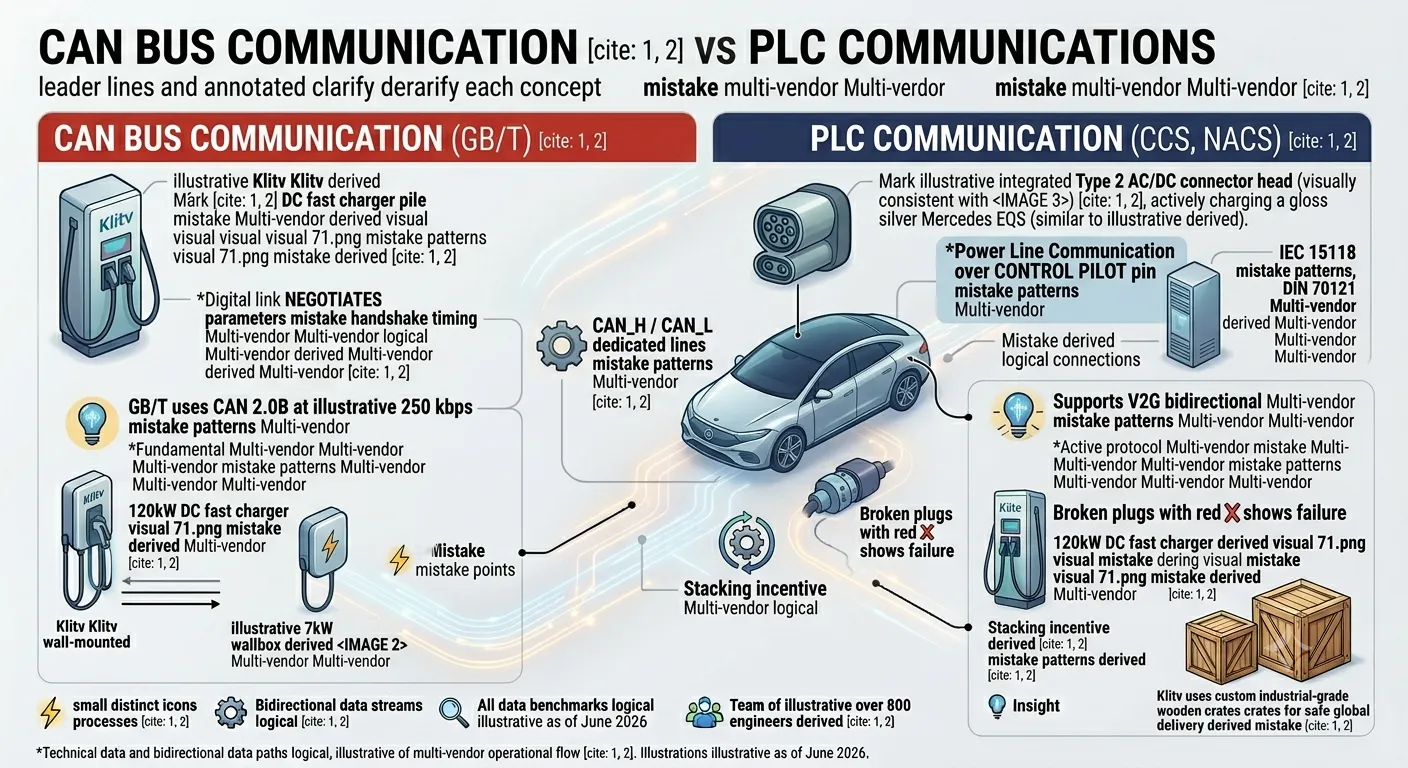
CCS and NACS both use Power Line Communication (PLC) over the Control Pilot pin, following ISO 15118 or DIN 70121. A passive mechanical adapter cannot bridge this gap. A proper GB/T-to-CCS adapter must include an active protocol converter.
Lena, an engineering manager at a German charging hardware company, spent three weeks in 2025 debugging why her team’s GB/T-to-CCS2 adapter kept failing handshake with BYD vehicles. The mechanical fit was perfect. The problem was entirely in software. Her team had used the CAN message sequence from GB/T 27930-2011, while the vehicles were running the updated 2024 version with different handshake timing. “The connector gets you plugged in, but the protocol gets you charging,” she told her team. “They are equally important.”
The 2023 Upgrade: From 250kW to 1.2MW
The numbers tell the story:
| Parameter | GB/T 20234.3-2015 | GB/T 20234.3-2023 | Change |
|---|---|---|---|
| Max DC Voltage | 1,000V | 1,500V | +50% |
| Max DC Current | 250A | 800A | +220% |
| Max DC Power | ~250kW | Up to 1.2MW | +380% |
| Cooling | Passive only | Liquid cooling supported | New |
| Temperature Monitoring | Not required | Integrated sensors required | New |
| Connector Cycles | 10,000 | 10,000 (unchanged) | — |
This was not just a paper upgrade. The 2023 revision added requirements for liquid-cooled cable assemblies, temperature sensing at the contact pins, and thermal management systems, the same technologies that enable 350kW+ charging on CCS and NACS networks. For project developers, this means a GB/T charger manufactured to the 2023 specification can serve both current vehicles and the next generation of high-power EVs without a hardware replacement.
For a deeper look at DC fast charging power levels, read our Level 3 EV charger guide.
GB/T vs CCS vs CHAdeMO vs NACS: A Practical Comparison
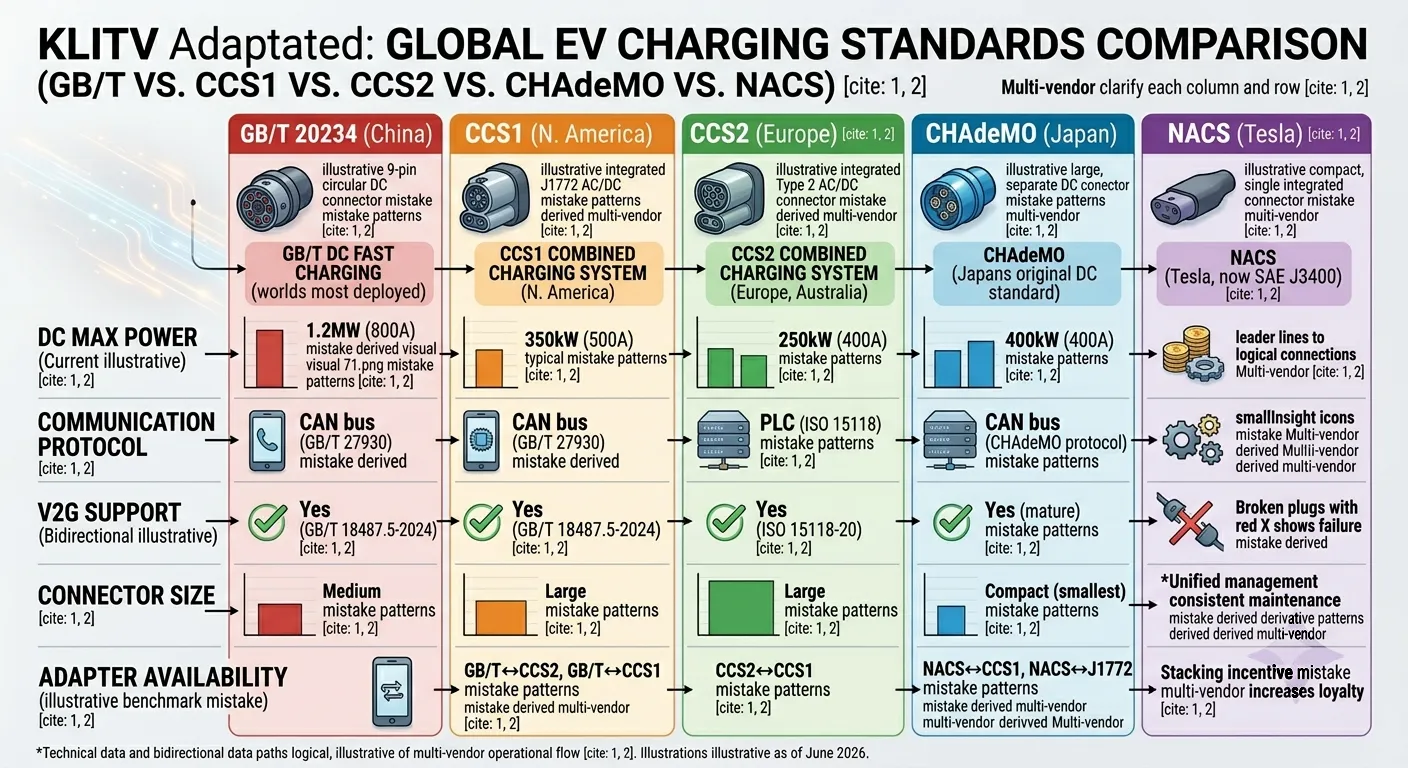
Choosing a charging standard is a business decision, not just a technical one. Here is how the four major standards compare across the dimensions that matter for charging projects:
| Feature | GB/T 20234 | CCS2 (Europe) | NACS/J3400 (N. America) | CHAdeMO (Japan) |
|---|---|---|---|---|
| Region | China (mandatory) | Europe, Australia, Middle East | North America (growing) | Japan (declining) |
| AC Connector | 7-pin, separate | Integrated Type 2 (Mennekes) | Integrated 5-pin | Separate J1772 |
| DC Max Power (Current) | 1.2MW (800A) | 350kW (500A) typical | 250kW (400A) V3 | 400kW (400A) |
| Communication | CAN bus (GB/T 27930) | PLC (ISO 15118) | PLC (ISO 15118) | CAN bus (CHAdeMO protocol) |
| Three-Phase AC | Yes (380V) | Yes (400V) | No | No |
| V2G Support | New in 2024 | Yes (ISO 15118-20) | Planned | Yes (mature) |
| Connector Size | Medium | Large (CCS1/2) | Compact (smallest) | Large, bulky |
| Adapter Availability | GB/T↔CCS2, GB/T↔CCS1, GB/T↔J1772 | CCS2↔CCS1, CCS2↔GB/T | NACS↔CCS1, NACS↔J1772 | CHAdeMO↔GB/T, CHAdeMO↔CCS |
What This Means for Your Project
If your charging stations will serve Chinese-brand EVs, whether in Asia, South America, the Middle East, or Africa, you need GB/T 20234 support. BYD, NIO, XPeng, Geely, and Great Wall Motors vehicles all use GB/T 20234 connectors in their domestic configurations. Many exported models also retain GB/T 20234 ports, especially in markets without a strong local charging standard mandate.
If your project is in Europe, CCS2 is the regulatory requirement, but stations near ports, logistics hubs, or areas with high numbers of Chinese EVs benefit from multi-standard support.
If you operate in North America, NACS is the direction the market is moving, but the transition from CCS1 will take years. Multi-standard chargers that support NACS, CCS1, and GB/T (via adapter) cover all possibilities.
The most practical approach for a global project in 2026 is to specify chargers with multi-standard capability. Hardware that supports at least two connector types, with clear adapter pathways for the others, protects your investment as vehicle fleets evolve.
Want to calculate the ROI of multi-standard vs single-standard chargers for your site? Try our EV charging ROI calculator.
The ChaoJi Transition: What GB/T 20234.4 Means for Procurement
ChaoJi is the next-generation ultra-fast charging standard co-developed by the China Electricity Council (CEC) and Japan’s CHAdeMO Association. Published as GB/T 20234.4-2023, it is designed to eventually replace the current GB/T DC interface, but the transition will take more than a decade.
What ChaoJi Delivers
ChaoJi pushes charging power to 900kW through 1,500V and 600A with active liquid cooling. That translates to roughly 400 kilometers of range in 5 minutes, competitive with the refueling time of a gasoline vehicle.
The standard has already cleared a major milestone: IEC recognition. The International Electrotechnical Commission published IEC TS 62196-7 in February 2026, formally incorporating ChaoJi into the international standards framework. An English-language version of GB/T 20234.4 is expected by early 2027, which will accelerate adoption outside China.
Critically, ChaoJi was designed with backward compatibility in mind. The IEC 62196-7 standard defines vehicle adapters that allow ChaoJi-equipped vehicles to charge on existing GB/T and CHAdeMO infrastructure. This means early adopters of ChaoJi vehicles will not be stranded, and existing charging stations gain an extended service life.
The Transition Timeline
Here is what the timeline looks like based on current policy and industry signals:
- 2023-2025: GB/T 20234.4 published; ChaoJi demonstration projects begin. Both standards coexist.
- 2025: China begins phasing out production of vehicles using the older GB/T interface. New models expected to adopt ChaoJi.
- 2026-2030: Gradual buildup of ChaoJi-capable charging infrastructure, especially on highways and in new commercial developments.
- 2030-2035: ChaoJi becomes the dominant DC standard in China. GB/T 20234.3 chargers remain operational but represent a declining share of new installations.
For charging project developers, the key takeaway is this: a GB/T DC charger purchased today will remain commercially viable for at least 10 years. The transition is slow by design, and backward compatibility is built into the standard. Do not delay procurement waiting for ChaoJi, but do verify that your supplier has a roadmap for ChaoJi-compatible hardware.
Sourcing GB/T-Compatible Chargers: What to Look For
If you are procuring EV chargers that support GB/T 20234, whether for projects in China, for Chinese EV export markets, or for multi-standard international deployments, here are the factors that separate reliable hardware from costly shortcuts.
Certifications That Matter
GB/T compliance alone is the minimum. For chargers that will be deployed internationally, verify these additional certifications:
| Certification | Region | What It Covers |
|---|---|---|
| CCC | China (mandatory) | Safety and EMC for products sold in China |
| CE | European Economic Area | Health, safety, and environmental protection |
| UL 2594 | North America | Safety standard for EV supply equipment |
| TÜV | Germany / EU | Third-party safety and quality testing |
| IATF 16949 | Global (automotive) | Quality management for automotive supply chain |
A manufacturer that holds multiple certifications has invested in meeting international quality standards, not just domestic minimums.
Build Quality Indicators
The connector is the component that endures the most physical stress in daily operation. Look for these quality signals:
- Connector cycle rating: minimum 10,000 mating cycles, per GB/T 20234.1
- Housing material: engineering-grade thermoplastic (PBT or PA66) with UL 94 V-0 flammability rating
- Contact material: silver-alloy plated copper, not bare copper or tin-plated contacts
- Weather protection: IP54 minimum with dust cap installed; IP67 for the connector body
- Cable construction: annealed copper conductors, not copper-clad aluminum
These are not abstract specifications. They directly affect how often a charger needs maintenance and how long it survives in outdoor conditions, from the humidity of Southeast Asia to the freeze-thaw cycles of Northern Europe.
Priya, a procurement director for an Indian charging network, learned this the hard way in 2024. She ordered 200 DC chargers from a low-cost supplier. The quoted specs looked identical to premium alternatives.
Eighteen months later, 34 units had failed connector assemblies. The silver-plated contacts her supplier promised were actually tin-plated, and corrosion at the contact points caused intermittent charging faults. Replacing the connectors cost more than the initial savings. Her team now requires a mandatory tear-down inspection of sample units before any bulk order.
When you are sourcing chargers for global deployment, look for manufacturers who:
- Operate their own production facilities with documented quality control processes
- Provide industrial-grade packaging rated for international shipping (wooden crates, not cardboard)
- Offer engineering support for installation and commissioning, not just a user manual
- Can supply the full range of connectors your project requires, GB/T 20234, CCS2, CCS1, and CHAdeMO, from a single source, simplifying logistics and support
For guidance on evaluating suppliers, read our article on EV charger manufacturers in China.
The best charger is one that arrives intact, installs without issues, and keeps running through years of heavy use.
Building a Multi-Standard Charging Strategy Around GB/T 20234
GB/T 20234 is central to any global EV charging strategy in 2026. Not because GB/T 20234 dominates every market, but because Chinese EVs do. With Chinese brands capturing an increasing share of global EV sales, the chargers that serve them must speak their language.
The good news is that the technology has matured. The 2023 revision brought GB/T DC charging to parity with the best that CCS and NACS offer. Multi-standard chargers are no longer a niche product; they are a practical procurement choice for forward-looking projects. And the ChaoJi transition, while real, is gradual enough that investments made today will deliver returns for years before any upgrade is needed.
The key is to work with manufacturers who understand the full standards landscape, not just one regional connector. From build quality and certifications to communication protocols and thermal management, the details determine whether a charger performs reliably over its service life.
Need chargers that support GB/T, CCS, and NACS for your next project? Contact Klitv’s engineering team for a technical consultation and custom proposal tailored to your site requirements and local vehicle fleet.