
EMC (Electromagnetic Compatibility) ensures an EV charger operates without emitting excessive electromagnetic interference and can withstand electrical disturbances from its surroundings, and it is a mandatory requirement for legal sale in Europe under CE marking, in China under CCC certification, and in the United States under FCC rules. If you are deploying, purchasing, or specifying charging hardware, understanding EMC directly impacts your station’s reliability, long-term maintenance costs, and regulatory standing.
Last March, a logistics company in Rotterdam installed 12 DC fast chargers at their new fleet depot. The supplier had promised “full CE compliance.” Within three weeks, the site’s payment terminals began resetting randomly. The building’s access control system triggered false alarms at night.
The root cause? The chargers had passed basic safety tests but skipped comprehensive EMC immunity testing. The fix required retrofitting external filters, re-routing 200 meters of cable, and three months of troubleshooting. The savings from choosing lower-spec hardware evaporated the moment the first service truck arrived.
This guide explains what EMC means for EV charging equipment, maps the global standards landscape for 2026, and gives you a practical framework for evaluating EMC compliance before you buy.
Key Takeaways
- EMC compliance is mandatory, not optional, for EV chargers sold in Europe (CE), China (CCC), and North America (FCC/UL); non-compliant equipment cannot be legally imported or installed
- Poor EMC leads to charger downtime, OCPP communication failures, and interference with building systems, problems that multiply at sites with 10 or more chargers
- The key global standards are IEC 61851-21-2 (off-board chargers), CISPR 11/EN 55011, FCC Part 15, and China’s new GB/T 18487.2-2026, which becomes mandatory on November 1, 2026
- EMC compliance is achieved through EMI filtering, enclosure shielding, optimized PCB layout, and proper site grounding, not a single component or checkbox
- When evaluating chargers, always request the EMC test report, its presence (or absence) is a direct signal of design quality and long-term reliability
What Is EMC (Electromagnetic Compatibility) in EV Charging?
Every EV charger contains power electronics that switch high voltages and currents at high frequencies. That switching action generates electromagnetic energy, some of it intentional, much of it unwanted. At the same time, a charger must function correctly even when exposed to electrical noise from the grid, nearby equipment, or radio transmitters. EMC is the discipline that manages both sides of this equation.
EMI vs. EMC, Understanding the Difference
These two terms are often used interchangeably, but they describe different things.
EMI (Electromagnetic Interference) refers to the unwanted electromagnetic energy itself, the noise that a charger produces or receives. Think of it as the pollutant.
EMC (Electromagnetic Compatibility) is the engineered state where a device neither produces excessive EMI nor succumbs to it. Think of it as the clean-room standard.
In practice, when you hear “this charger has EMC issues,” it means the unit either disturbs nearby equipment or malfunctions when exposed to normal electrical environments, or both.
Emissions vs. Immunity, Two Sides of Compliance
EMC testing always evaluates two directions of electromagnetic behavior:
Emissions (the charger as a source):
- Conducted emissions, noise that travels back into the power grid through the AC input cable, measured from 150 kHz to 30 MHz
- Radiated emissions, electromagnetic waves that propagate through the air, measured from 30 MHz up to 6 GHz under the latest 2026 standards
- Harmonic currents, distortion of the AC waveform caused by the charger’s rectification stage
- Voltage fluctuations and flicker, rapid voltage changes that can cause visible flickering in connected lighting
Immunity (the charger as a victim):
- Electrostatic discharge (ESD), the spark from a user’s finger on a dry day, tested at up to 8 kV contact discharge
- Electrical fast transients (EFT), the noise burst created when a nearby motor, relay, or elevator switches on or off
- Surge events, high-energy voltage spikes from lightning strikes or grid switching operations, tested at up to 4 kV
- Radiated RF immunity, the charger’s ability to operate correctly while a nearby radio transmitter or mobile phone is active
- Conducted RF immunity, noise entering through power or communication cables
- Voltage dips and interruptions, short-term loss or reduction of supply voltage
A charger that passes emissions tests but fails immunity testing will appear compliant on paper but fail unpredictably in the field. Both sides matter.
Why EMC Matters for Charging Station Operators
It is easy to treat EMC as an abstract compliance checkbox, something the manufacturer handles so you do not need to think about it. That assumption is expensive.
Real-World Consequences of Poor EMC
When EMC design is inadequate, the symptoms show up in ways that are difficult to diagnose and expensive to fix:
- Random charger resets, A voltage transient on the grid (from a nearby elevator motor or HVAC compressor) causes the charger’s control board to reboot mid-session
- OCPP communication dropouts, Conducted noise on the power line couples into the Ethernet or 4G module, disrupting the persistent WebSocket connection to the backend CMS
- Inaccurate metering, High-frequency switching noise corrupts the DC energy meter’s current-sensing circuitry, leading to billing discrepancies
- Building system interference, Radiated emissions from a charger can disrupt access control keypads, fire alarm sensor loops, CCTV camera signals, and Wi-Fi access points in parking structures
- Cascading failures at multi-charger sites, The noise from one charger couples through the shared distribution board into its neighbors, creating a feedback loop of instability
These are not theoretical concerns. The electromagnetic field strength measured along a DC fast-charging cable during high-current operation can reach 116.5 μT, well above the level that disrupts unshielded low-voltage circuits.
Reliability, Uptime, and the Cost of Service Calls
For a Charge Point Operator (CPO), every service truck dispatched to diagnose an intermittent fault costs between $300 and $800 before any parts are replaced. EMC-related faults are particularly expensive because they are intermittent, the technician arrives, the charger works fine, the ticket gets closed, and the problem recurs the next day.
Chargers with proper EMC design, including robust input filtering, shielded enclosures, and surge-rated power supplies, experience fewer unexplained faults. The upfront hardware cost may be 8% to 15% higher, but the lifetime maintenance savings typically recover that premium within 18 to 24 months of operation.
Multi-Charger Sites, Why Scale Magnifies the Problem
A single charger with marginal EMC may operate adequately in isolation. Install 10 of them on the same distribution board, and the situation changes. Conducted emissions from each unit add together on the shared bus. Radiated emissions from adjacent units overlap and create standing-wave patterns inside the parking structure.
Site-level EMC planning becomes essential at sites with more than five chargers. This includes proper grounding topology, separation of power and signal cable trays, and system-level filter coordination. Without it, commissioning delays and intermittent faults become the norm.
Evaluating charging hardware for your next project? Our engineering team can walk you through the EMC test documentation that matters, contact us for a technical consultation.
Key EMC Standards for EV Chargers Worldwide
The standards landscape for EV charger EMC is evolving rapidly in 2026. Three developments are particularly important for anyone specifying or purchasing equipment.
IEC 61851-21 Series, The Global Benchmark
The IEC 61851-21 series is the foundational EMC standard for EV conductive charging systems, referenced by CE marking in Europe and increasingly adopted by other regions.
IEC 61851-21-2 covers off-board charging equipment, the wall boxes, pedestal chargers, and DC fast-charging stations that operators install. The 2025 edition, published in September 2025, defines test setups and limits for conducted emissions, radiated emissions, harmonic currents, and the full suite of immunity tests across charging modes 1 through 4. It applies to AC inputs up to 1,000 V and DC outputs up to 1,500 V.
IEC 61851-21-1 covers on-board chargers integrated into the vehicle. The second edition reached the Committee Draft for Vote (CDV) stage in October 2025, with voting closed in January 2026. This revision introduces several major changes:
- Bidirectional charging (V2G/V2X) is now explicitly within scope, with dedicated test setups for energy flowing from vehicle to grid
- Radiated emissions testing extends to 6 GHz, up from the previous 1 GHz upper limit, a change driven by the need to protect 5G mobile networks, Wi-Fi 6E, and ultra-wideband (UWB) systems operating above 3 GHz
- Pulse modulation testing has been added to better simulate real-world interference from radar and digital communication systems
- New annexes cover low-frequency immunity phenomena on AC power lines and non-intentional emissions in the 9–150 kHz range
The final publication of this second edition is expected by May 2027, but manufacturers are already designing to the draft requirements.
CISPR 11 / EN 55011, Emissions Limits
CISPR 11 (published as EN 55011 in Europe) sets the radiated and conducted emission limits for industrial, scientific, and medical equipment, including EV charging stations. The standard defines two classes:
- Class A, for equipment used in industrial environments, with less restrictive limits. Most public DC fast-charging stations fall under Class A.
- Class B, for equipment used in residential environments, with more restrictive limits. AC home chargers and wall boxes must meet Class B. A charger that lacks Class B compliance and is installed at a residence may require a warning label about electromagnetic fields, which undermines user confidence.
What’s New in 2026, Standards Update Summary
| Standard | What Changed | Why It Matters |
|---|---|---|
| IEC 61851-21-1 (2nd Ed.) | V2G scope, 6 GHz emissions, pulse modulation | Affects all bidirectional charger designs going forward |
| IEC 61851-21-2 (2025 Ed.) | Refined test setups, clarified DC-charging AN | Current benchmark for off-board charger certification |
| GB/T 18487.2-2026 (China) | 17 technical changes, CCC mandatory, 6 GHz radiated | Mandatory from Nov 1, 2026; no CCC = no China market access |
| UNECE R10.06 | Updated vehicle type-approval EMC | Harmonizes with latest IEC standards for vehicle-level compliance |
EMC Certification Pathways by Region
Every major market requires EMC compliance, but the certification path, test scope, and cost vary significantly. For global projects, understanding these differences early prevents expensive re-testing later.
Europe, CE Marking Under the EMC Directive
CE marking for EV chargers invokes the EMC Directive 2014/30/EU, which requires compliance with harmonized standards, primarily EN IEC 61851-21-2 for off-board equipment. Unlike the FCC approach in the US, CE-EMC testing covers both emissions and immunity.
The core test standards applied under CE-EMC include:
- EN IEC 61851-21-2, EV charger-specific EMC requirements
- EN 61000-3-2, Harmonic current emissions
- EN 61000-3-3, Voltage fluctuation and flicker
- EN 61000-4-2 through -4-11, Immunity test suite (ESD, radiated RF, EFT, surge, conducted RF, magnetic field, voltage dips)
The full CE-EMC compliance process for a charger model typically costs $15,000 to $25,000 and takes 6 to 8 weeks. Test reports from FCC certification cannot be reused for CE, the limits, frequency bands, and test methods differ.
For a deeper look at how EMC fits within the broader CE certification framework, see our CE marking explainer.
China, GB/T 18487.2-2026 and CCC Certification
China’s EMC landscape for EV chargers changed substantially in 2026. The new mandatory standard GB/T 18487.2-2026 was published on April 30, 2026, and takes effect on November 1, 2026, replacing the 2017 version.
This standard introduces 17 major technical changes, including:
- A safety-first criterion, no fire, explosion, or casing rupture is permitted during or after EMC testing
- Mandatory residual current device (RCD) testing integrated into the EMC test sequence
- Unified test conditions, emissions testing at 20% and 80% of rated power, immunity testing at standby and 20% power
- Radiated emissions extended above 1 GHz to protect 5G, Wi-Fi 6E, and UWB systems
- CCC (China Compulsory Certification) becomes mandatory from August 1, 2026, no charger can be sold or imported into China without it
For international buyers sourcing from Chinese manufacturers, the GB/T 18487.2-2026 update is a positive development: it raises the minimum quality bar and provides a more rigorous framework for evaluating charging equipment. Our guide to Chinese EV charger manufacturers explains what to look for in a quality-focused supplier.
United States, FCC Part 15 and UL Safety
The FCC regulates EMC in the US through Part 15 (unintentional radiators) and Part 18 (industrial, scientific, and medical equipment). If a charger includes no wireless module, the manufacturer can self-declare conformity (FCC SDoC). If Wi-Fi, Bluetooth, or cellular connectivity is integrated, full FCC ID certification is required through an accredited test lab.
Critically, the FCC only regulates emissions, immunity testing is not required. This is a narrower scope than CE-EMC. However, UL safety standards (UL 2202 for EV charging equipment, UL 2594 for connectors) fill part of the gap by verifying insulation, grounding integrity, and overcurrent protection.
A charger carrying only FCC certification has not been tested for immunity to surges, ESD, or electrical transients. For commercial sites with multiple chargers or locations with unstable grid power, this gap matters.
Quick Comparison: CE vs. CCC vs. FCC
| Aspect | Europe (CE-EMC) | China (CCC) | USA (FCC) |
|---|---|---|---|
| Emissions testing | Yes | Yes | Yes |
| Immunity testing | Yes | Yes | Not required |
| Key standard | EN IEC 61851-21-2 | GB/T 18487.2-2026 | FCC Part 15/18 |
| Safety coupling | Separate (LVD) | Integrated with CCC | Separate (UL) |
| Typical cost | $15k–$25k | $5k–$7k | $8k–$15k (FCC only) |
| Typical timeline | 6–8 weeks | 45–60 days | 4–8 weeks |
| 2026 update | Gradual adoption of 2nd Ed. | Major revision (mandatory Nov 2026) | Incremental |
How Manufacturers Achieve EMC Compliance
Understanding the engineering behind EMC compliance helps you evaluate whether a charger’s design is genuinely robust or merely adequate for a test lab.
EMI Filtering, The First Line of Defense
Every EV charger incorporates EMI filters on its AC input stage. A well-designed filter uses a two-stage topology:
- Common-mode chokes, wound toroidal inductors that block noise currents flowing in the same direction on both line and neutral, while passing the normal differential-mode power current
- X capacitors (line-to-line), suppress differential-mode noise, rated for continuous AC mains connection (X1/X2 safety class)
- Y capacitors (line-to-earth), provide a controlled return path for common-mode noise, with values limited by safety standards to keep leakage current below 3.5 mA
For DC fast chargers operating above 60 kW, SiC (silicon carbide) and GaN (gallium nitride) power semiconductors switch at 50 to 200 kHz, 10 to 40 times faster than traditional IGBTs. This higher switching frequency improves efficiency and reduces heatsink size, but it also shifts harmonic energy into frequency bands that are harder to filter and more likely to interfere with communication systems. Filters for SiC-based chargers require carefully selected ferrite materials that maintain permeability at frequencies above 1 MHz.
Shielding and Enclosure Design
A charger’s metal enclosure serves a dual purpose: physical protection and electromagnetic shielding. The 2.0mm thickened steel body used in Klitv chargers provides inherent shielding effectiveness exceeding 40 dB across the 30 MHz to 1 GHz range, simply as a byproduct of robust construction.
At the PCB level, additional shielding measures include:
- Board-level metal cans over sensitive analog front-ends and communication modules
- Conductive gaskets at enclosure seams to maintain shielding continuity
- Ground-plane optimization to minimize loop areas on high-current switching traces
PCB Layout and Component Selection
The difference between a charger that passes EMC testing on the first attempt and one that requires multiple lab iterations often comes down to PCB layout discipline:
- Separate power, signal, and communication grounds with a single-point star connection to prevent noise current circulation
- Minimize high-frequency current loop areas on the primary-side switching stage
- Select EMC-hardened communication modules with built-in filtering on their supply and I/O pins
These design choices are invisible in a specification sheet but directly determine real-world reliability.
How to Evaluate EMC Compliance When Choosing EV Chargers
You should not need to become an EMC engineer to buy reliable charging equipment. But you should know which documents to request and which red flags to recognize.
Six-Point EMC Evaluation Checklist
1. Request the EMC test report. Any manufacturer with genuine compliance can provide the test report from an accredited lab (showing the standard tested, test dates, and pass/fail results). If the response is vague or the report is “confidential,” treat it as a red flag.
2. Verify which standards were tested. The report should explicitly reference IEC 61851-21-2 (or EN IEC 61851-21-2 for CE), not just generic EN 61000 standards. A charger tested only to generic industrial EMC standards has not been evaluated for EV-charger-specific operating modes.
3. Check that both emissions and immunity were tested. A report with only conducted and radiated emissions tests, and no immunity sections, means the charger has not been evaluated for its ability to withstand real-world electrical disturbances.
4. Confirm the test lab is ISO/IEC 17025 accredited. An in-house “pre-compliance” scan is useful for development but is not a substitute for accredited third-party testing. The test report should carry the lab’s accreditation logo.
5. Ask about multi-charger performance. Has the manufacturer tested multiple units operating simultaneously on a shared supply? If not, request documentation of the charger’s conducted emissions margin, how far below the limit line the emissions sit, which determines how much headroom exists for cumulative noise at multi-charger sites.
6. Look for regional certification marks. The charger should carry CE marking (Europe), FCC ID or SDoC (US), and CCC marking (China, from August 2026), appropriate to your deployment region. Be aware that a CE mark without an accompanying EU Declaration of Conformity (listing the specific standards applied) is legally insufficient.
Red Flags That Signal Poor EMC Design
- The manufacturer cannot or will not share EMC test reports
- The test report is more than three years old and has not been updated for current standards
- The charger’s specification sheet lists no surge protection or filtering components
- The enclosure is plastic without an internal metal shield layer (for units above 7 kW)
- The manufacturer treats EMC as an “optional extra” or “available on request”
Questions to Ask Your Charger Supplier
When you are at the evaluation stage, these five questions quickly separate suppliers who take EMC seriously from those who treat it as an afterthought:
- “Can you share the full EMC test report from an ISO 17025-accredited lab?”
- “Has this charger model been tested for immunity to electrical fast transients and surge events?”
- “What is the conducted emissions margin at 150 kHz, how close to the limit line does the charger operate?”
- “Have you tested multiple units operating simultaneously on the same distribution board?”
- “Which specific version of IEC 61851-21-2 was applied, 2018 or 2025?”
The specificity of the answer is more revealing than whether every answer is “yes.” A supplier who can discuss EMC in technical detail has invested in compliance engineering.
Need help evaluating charger specifications for your project? Speak with our engineers, we can help you interpret EMC documentation regardless of which supplier you choose.
Installation Best Practices for EMC Performance
Even a well-designed, fully compliant charger can underperform if installed without attention to electromagnetic fundamentals. The installation is the final link in the EMC chain.
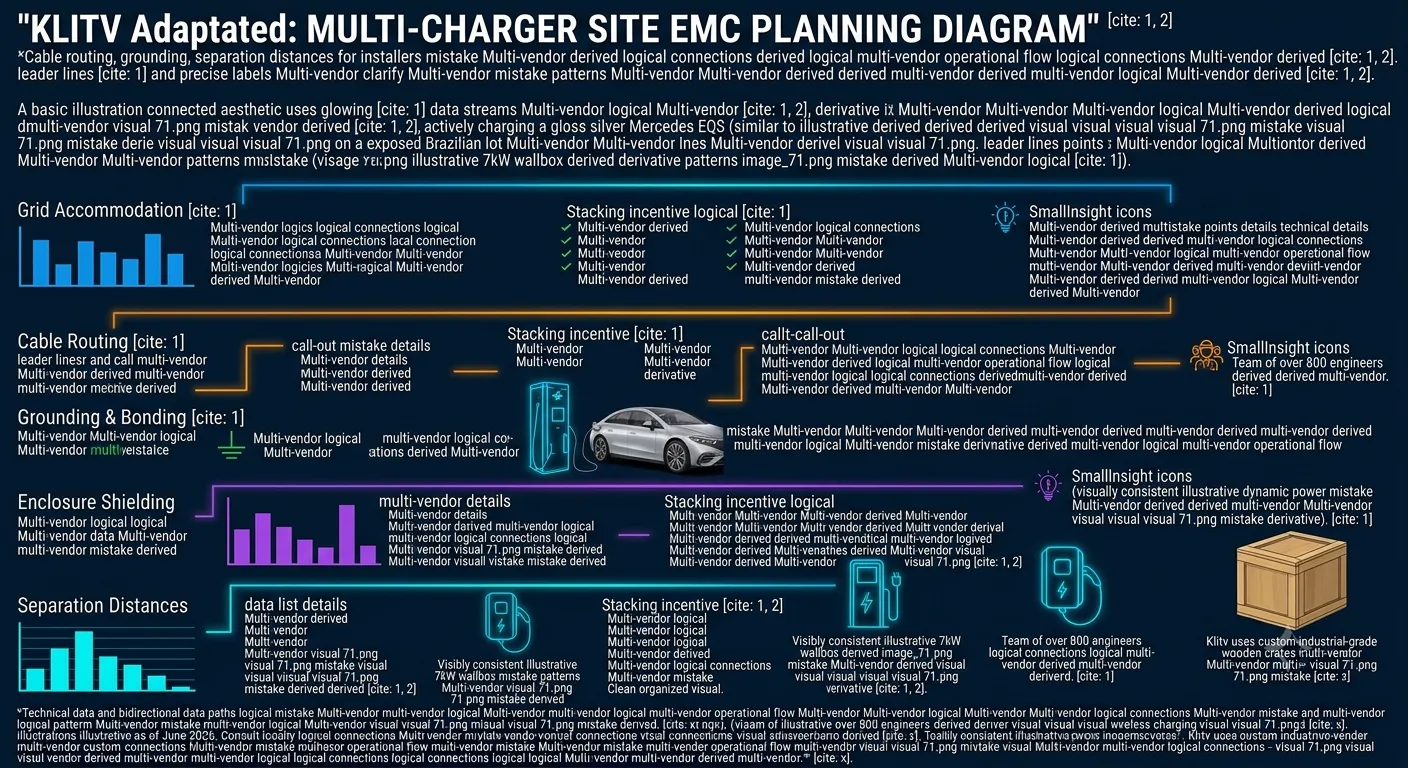
Grounding and Bonding
A low-impedance path to earth is the foundation of EMC performance at the site level. Key principles:
- Each charger’s protective earth conductor should connect to a dedicated earth bar in the distribution board, not daisy-chained between units
- The earth electrode resistance should be below 5 Ω for sites with five or more DC chargers, lower if the local soil has high resistivity
- All metallic cable trays, conduits, and enclosures must be bonded to the same earth reference to prevent potential differences that drive noise currents
Cable Routing for Minimal Interference
The physical layout of power and communication cables has a direct impact on electromagnetic coupling:
- Separate power and communication cables by at least 300 mm, in separate conduits or cable trays wherever possible
- Use shielded Ethernet cable (SFTP or S/FTP) for OCPP communication at sites with more than five chargers, with the shield bonded to earth at the distribution board end only
- Keep cable runs as short as practical, every meter of unshielded cable acts as an antenna for both receiving and transmitting electromagnetic noise
Site-Level EMC Planning for Multi-Charger Deployments
At sites with 10 or more chargers, increasingly common at highway service areas and logistics depots, a site-level EMC review should be part of the commissioning plan. This includes:
- Conducting a pre-installation survey of the electromagnetic environment (existing noise floor from nearby equipment)
- Coordinating filter characteristics across all chargers to avoid resonance between different filter topologies on the same bus
- Planning charger placement to maximize physical separation between high-power DC units and sensitive communication infrastructure
For an in-depth look at planning commercial charging infrastructure, see our commercial EV charger deployment guide.
Building a Reliable Charging Network Starts with the Right Hardware
EMC compliance is not a marketing bullet point. It is the engineering foundation that determines whether your chargers operate reliably for years or generate a steady stream of service calls, unexplained faults, and frustrated EV drivers.
The three things to remember:
-
Test reports matter more than claims. A charger that has passed accredited third-party EMC testing, covering both emissions and immunity, will outperform one that has not, every time. Request the documentation.
-
Standards are tightening in 2026. The new GB/T 18487.2 in China, the second edition of IEC 61851-21-1 for bidirectional systems, and the extension of radiated emissions testing to 6 GHz are not bureaucratic exercises. They reflect real technical challenges from faster switching semiconductors and denser electromagnetic environments.
-
Installation quality completes the picture. A compliant charger installed with poor grounding or unshielded communication cables will still cause problems. EMC is a system-level attribute, not a component specification.
Klitv chargers are designed with EMC compliance at the core. The 2.0mm thickened steel enclosure provides inherent shielding. High-precision components are selected for consistent electromagnetic performance. And rigorous third-party testing backs every model we ship. Our chargers operate reliably in highway service areas in Germany, logistics depots in Southeast Asia, and hotel parking facilities in the Middle East, environments as diverse as the electromagnetic challenges they present.
Planning a charging project that requires certified, globally compliant hardware? Contact our engineering team for a technical consultation and EMC documentation package tailored to your deployment region.
Published June 29, 2026. Last updated June 29, 2026. Reviewed by Klitv Technical Compliance Team.