
A Charge Point Operator (CPO) is the entity responsible for installing, managing, and maintaining EV charging stations. They handle hardware deployment, network monitoring, billing, maintenance, and regulatory compliance. But becoming a successful CPO takes more than ambition and software. It starts with choosing charging hardware that delivers reliability, interoperability, and long-term value.
When Marcus launched his first EV charging hub outside Frankfurt in early 2025, he spent months evaluating software platforms. He compared CMS dashboards, read API documentation, and negotiated roaming agreements down to the per-kWh rate. Six months after launch, three of his eight DC fast chargers were offline. Not because of software bugs, but because the hardware he selected could not handle continuous operation in wet, sub-zero winter conditions. The supplier warranty process took 11 weeks. Marcus lost an estimated EUR 47,000 in revenue. Worse, he lost the trust of fleet operators who had signed contracts based on his uptime guarantees.
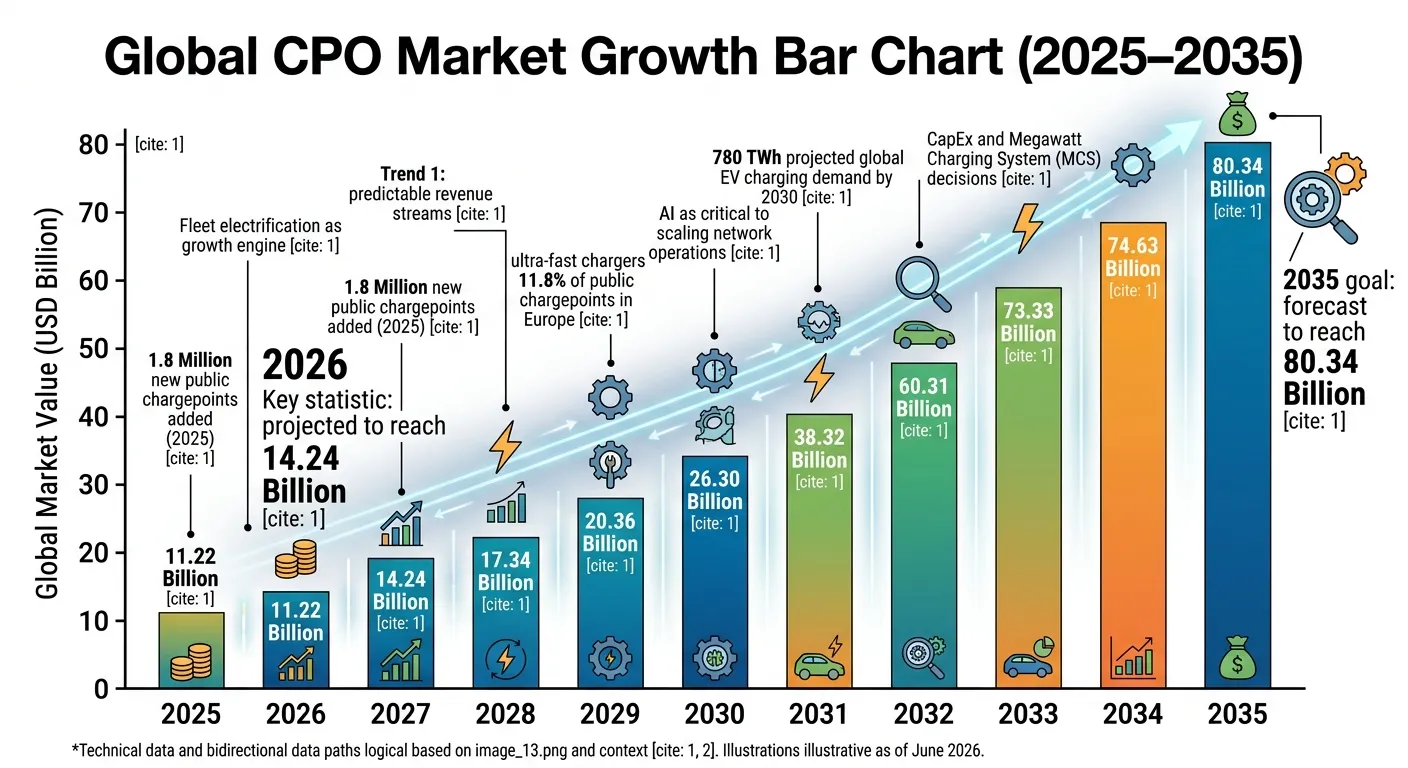
The global CPO market reached USD 11.22 billion in 2025. It is projected to hit USD 14.24 billion in 2026, growing at 21.19% CAGR through 2035, according to Next Move Strategy Consulting. With 1.8 million new public chargepoints added globally in 2025 alone, the opportunity is real. But as Marcus discovered, the gap between deploying chargers and running a profitable network comes down to one decision that most industry guides overlook: choosing hardware from a manufacturer who treats CPOs as long-term partners, not one-time buyers.
Whether you are an experienced EV charging station operator expanding into new markets or an entrepreneur starting your first charging site, this guide covers everything: CPO fundamentals, business models, hardware selection, and a practical framework for evaluating EV charger manufacturers. You will learn how to build a charging network that stays operational, earns driver trust, and delivers sustainable returns.
Key Takeaways
- A Charge Point Operator owns or manages EV charging stations. They handle installation, uptime, billing, maintenance, and regulatory compliance across all sites.
- The global CPO market is projected to reach USD 14.24 billion in 2026. Fleet electrification and ultra-fast charging are driving 21.19% annual growth through 2035.
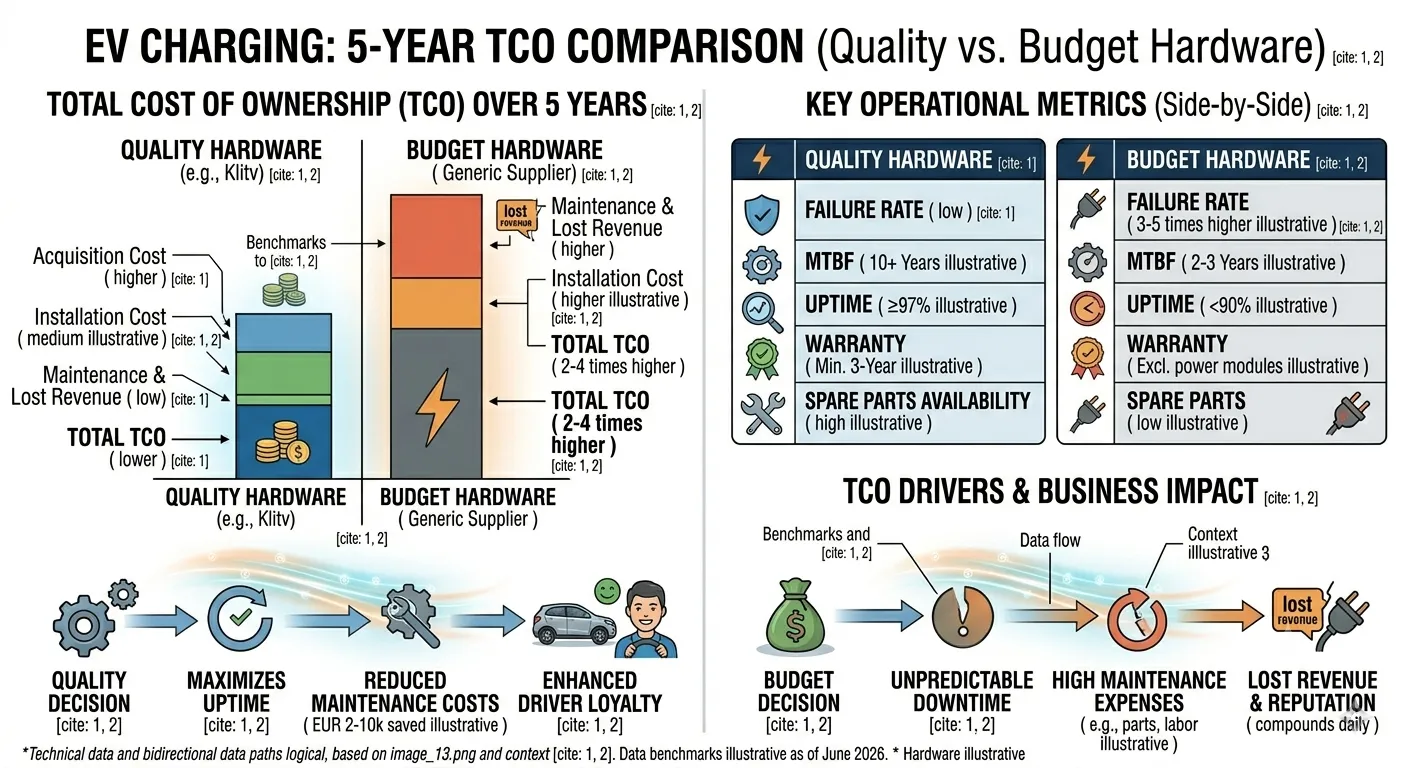
- Hardware selection is the single most consequential CPO decision. A charger priced 20% lower that fails three times more often costs 2 to 4 times more over five years in lost revenue and maintenance.
- CPO profitability in 2026 depends on three operational priorities: frictionless driver experience, smarter energy management, and data-driven maintenance. All three start with reliable, OCPP-compliant hardware.
- Klitv provides charge point operators with durable, intelligent EV chargers spanning 7kW AC to 720kW liquid-cooled DC. Every charger is backed by 800+ engineers and proven global delivery to over 75 countries.
What Is a Charge Point Operator? Definition, Roles, and Business Models
CPO Definition and Core Responsibilities
A Charge Point Operator (CPO) is the organization that owns, manages, or operates EV charging stations. The CPO sits at the operational center of the EV charging ecosystem. Drivers interact with an app or RFID card on the front end. The CPO is the entity making sure the physical charger actually works when someone plugs in.
The core responsibilities of a charge point operator include:
- Hardware installation and commissioning: procuring chargers, managing civil and electrical works, and bringing stations online
- Network monitoring and maintenance: using a Charging Station Management System (CSMS) to track real-time status, diagnose faults, and dispatch repairs
- Pricing and billing management: setting tariffs (per kWh, per minute, per session), processing payments, and managing roaming partner settlements
- Energy management: balancing power across chargers, managing peak demand, and integrating on-site storage or renewables where applicable
- Regulatory compliance: meeting regional requirements such as AFIR in Europe or NEVI in the United States, including uptime mandates and data-sharing obligations
- Driver support: handling customer inquiries, refund requests, and accessibility requirements
In practical terms, the CPO is the entity that turns a piece of electrical equipment into a revenue-generating service. Without effective CPO operations, even the most advanced charger is just metal and circuitry sitting idle in a parking space.
Who Can Become a CPO?
The CPO model is open to a wide range of organizations. There is no single path into the business, which is part of why the market is growing so quickly:
| Organization Type | Typical Approach | Example Use Case |
|---|---|---|
| Property owners and developers | Install chargers on owned land; operate directly or contract management | Shopping malls, office parks, residential complexes |
| Utilities and energy companies | use existing grid infrastructure and customer relationships | Regional power companies expanding into e-mobility |
| Fleet operators | Build depot charging for owned vehicles; may sell excess capacity publicly | Logistics companies, transit agencies, rental car fleets |
| Automotive OEMs and dealers | Deploy branded networks to support vehicle sales and customer loyalty | Tesla Supercharger network, OEM-backed fast-charging corridors |
| Independent entrepreneurs | Identify high-demand locations, lease sites, operate charging as a business | Standalone charging hubs at highway exits or urban centers |
| Fuel retailers and convenience stores | Add EV charging alongside existing fuel pumps and retail operations | Gas station chains transitioning to multi-energy hubs |
CPO vs eMSP: What Is the Difference?
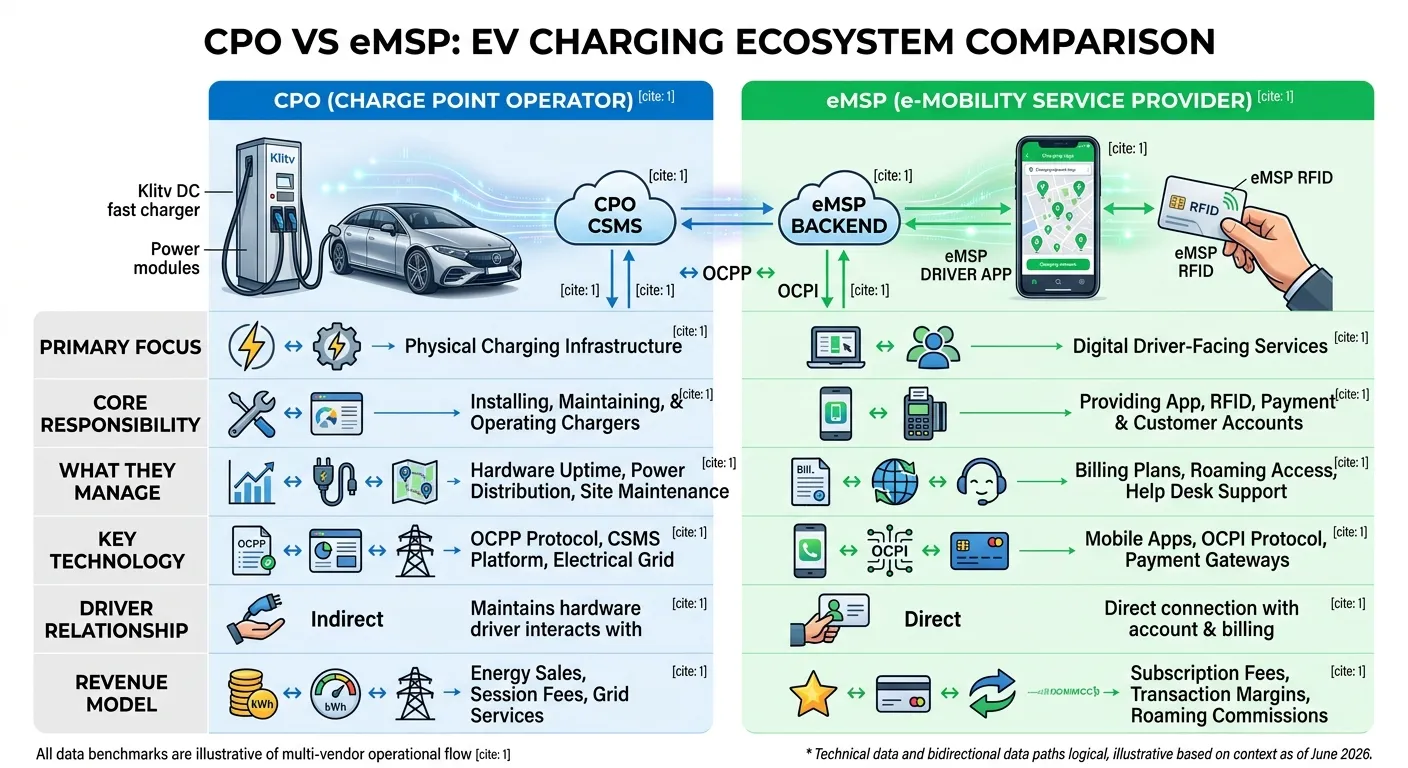
One of the most common points of confusion in the EV charging industry is the distinction between a CPO and an eMSP (e-Mobility Service Provider). While a single company can serve both roles, they are legally and operationally distinct functions:
| Aspect | CPO (Charge Point Operator) | eMSP (e-Mobility Service Provider) |
|---|---|---|
| Primary focus | Physical charging infrastructure | Digital driver-facing services |
| Core responsibility | Installing, maintaining, and operating chargers | Providing apps, RFID cards, payment processing, and customer accounts |
| What they manage | Hardware uptime, power distribution, site maintenance | Billing plans, roaming access across networks, help desk support |
| Key technology | CSMS, OCPP protocol, electrical infrastructure | Mobile apps, OCPI protocol, payment gateways |
| Driver relationship | Indirect; driver uses the charger the CPO maintains | Direct; driver logs into the eMSP app or uses their RFID card |
| Revenue model | Energy sales, session fees, grid services | Subscription fees, transaction margins, roaming commissions |
Think of it this way: the CPO makes sure the charger works. The eMSP makes it easy for drivers to find, access, and pay for a charging session. Many successful charging networks operate as integrated CPO-eMSPs. But understanding the distinction matters when evaluating partnerships, software platforms, or regulatory obligations.
The Charge Point Operator Market in 2026: Growth, Trends, and Opportunities
The charge point operator market is in the middle of a structural shift. It is moving from a phase of rapid, subsidy-driven deployment toward one of enforced operational efficiency and profitability.
Market Size and Key Statistics
The numbers paint a clear picture of accelerating demand:
- The global CPO market is valued at USD 11.22 billion in 2025. It is forecast to reach USD 80.34 billion by 2035, representing a compound annual growth rate of 21.19% (Next Move Strategy Consulting).
- 1.8 million new public chargepoints were added worldwide in 2025, a 33% year-over-year increase (IEA Global EV Outlook 2026).
- Ultra-fast chargers (150 kW and above) now represent 11.8% of all public chargepoints in Europe, up from 9.4% in 2024 (gridX Europe EV Charging Report 2026).
- Global EV charging demand is projected to reach 780 TWh by 2030.
- 67% of network operators now view AI as very important or critical to scaling their operations (Driivz 2026 State of EV Charging Network Operators).
Three Trends Reshaping the CPO Role in 2026
Trend 1: Fleet Electrification Is the Hidden Growth Engine
While passenger EV adoption grabs headlines, fleet electrification is quietly creating the most predictable revenue streams for CPOs. Global electric truck sales grew approximately 80% in 2024 (IEA). Major logistics operators, including DHL, UPS, and FedEx, have committed to deploying thousands of electric vehicles by 2026. Fleet depot charging is fundamentally different from public charging: utilization is contractually guaranteed, energy consumption per session is higher, and site requirements involve coordination with fleet operating schedules rather than walk-in convenience.
Trend 2: From Range Anxiety to Charge Anxiety
A counterintuitive shift is underway. J.D. Power’s 2025 EV Charging Study found that failed charging visits actually improved, dropping from 19% to 14%. Yet overall driver satisfaction declined. The reason? As basic charger availability improves, driver expectations shift toward price transparency, payment simplicity, and consistent session quality. For operators, this means hardware uptime alone is no longer enough. Drivers now judge a charging network by how easy it is to pay, how clear the pricing is before they plug in, and whether the session completes without interruption.
Trend 3: The Megawatt Charging Era Begins
The commercial introduction of the Megawatt Charging System (MCS), delivering 1,000 kW to 3,750 kW, marks a new chapter for heavy-duty vehicle charging. Scania released its first MCS-enabled electric trucks in early 2026. Truck manufacturers are aligning around MCS as the standard for long-haul electric freight. For CPOs, MCS represents both a major CapEx decision and a revenue opportunity. A single MCS-enabled truck stop can serve as many vehicles per day as a 12-stall passenger car fast-charging station, with higher per-session revenue.
Why 2026 Is a Strategic Entry Point
Several factors make 2026 a particularly important year for new and scaling CPOs:
- Regulatory deadlines are crystallizing: The EU AFIR mandates ISO 15118 Plug & Charge compliance for new public chargers from January 2026 and DATEX II data reporting from April 2026. The U. S. NEVI program 97% uptime requirement is now actively enforced.
- Grid connection timelines have tripled: Securing a grid connection now takes 18 to 24 months in many regions, up from 6 months two years ago. CPOs who begin the interconnection process now will capture demand when competitors are still waiting in the queue.
- Hardware costs are stabilizing: Charger manufacturing has matured after years of supply chain disruption. Stationary battery prices fell 8% to approximately USD 108/kWh, making on-site storage economically viable for the first time at scale.
Ready to evaluate hardware for your CPO project? Explore Klitv’s full range of OCPP-compliant chargers at our products hub.
How to Become a Charge Point Operator: A Step-by-Step Guide
Building a CPO business from the ground up is a 6-to-18-month journey, depending on your market, site complexity, and grid readiness. The following seven steps provide a structured roadmap, with particular attention to the step most guides skip: hardware procurement and manufacturer evaluation.
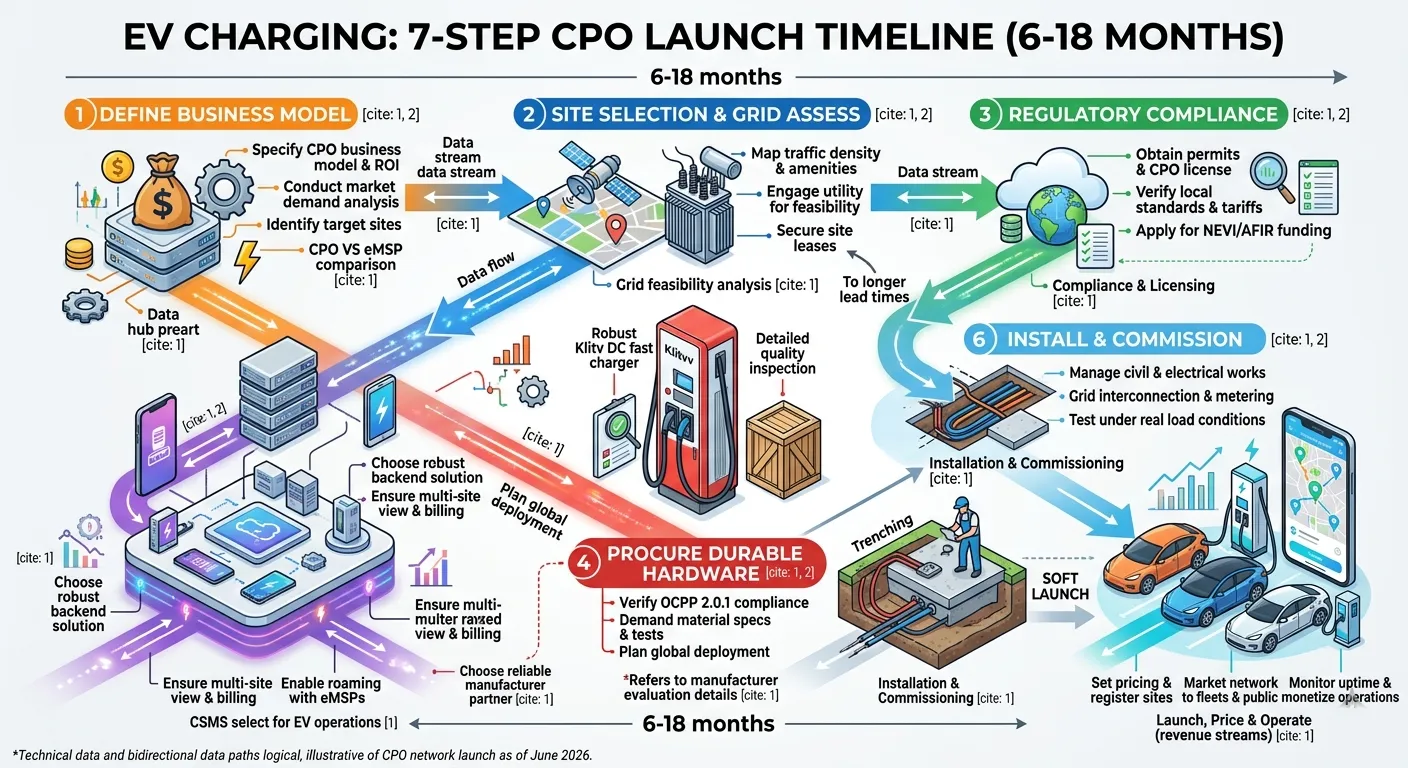
Step 1: Define Your Business Model and Market
Before buying equipment or signing leases, get clear on your operating model. Your charge point operator business model determines everything from revenue expectations to hardware requirements. The three most common CPO business models are:
- Owner-operator: You own or lease the land, purchase the hardware, and retain 100% of revenue. This model requires the most upfront capital but delivers the highest long-term margin.
- Revenue-sharing / site-host partnership: You partner with a property owner who provides the location. Revenue is split according to a negotiated agreement. This model reduces capital requirements and is common in retail, hospitality, and parking facility deployments.
- Charging-as-a-Service (CaaS): A third party installs and operates the equipment on your site in exchange for a recurring fee or revenue share. This is the lowest-risk entry point for property owners who want to offer EV charging without building operational expertise.
Conduct demand analysis early. Study EV registration data in your target region. Map competitor locations and identify gaps where EV fleets are growing but public charging options remain limited.
Step 2: Select Sites and Assess Grid Feasibility
Site selection is often described as the single most strategic CPO decision. A charger in a high-demand location with convenient access and nearby amenities will achieve 3 to 5 times the utilization of a charger placed without demand data.
Key site evaluation criteria:
- Current and projected EV traffic density
- Proximity to the electrical grid and available transformer capacity
- Parking layout, accessibility, and turning radius for larger vehicles
- Lease stability and landlord willingness to accommodate electrical upgrades
- Nearby amenities: drivers value food, restrooms, and retail during charging sessions
- Visibility from major roads and presence on navigation apps
Engage the local distribution utility early. Grid interconnection timelines are the number one bottleneck in CPO project timelines. Lead times of 12 to 24 months are now common in many regions. Starting the utility conversation during site evaluation, not after signing a lease, can save months of idle time.
Step 3: Navigate Regulatory Requirements and Licensing
Regulatory requirements for charge point operators vary significantly by region. The trend is toward more structured oversight in all major markets:
European Union (AFIR): The Alternative Fuels Infrastructure Regulation requires all new and renovated public chargers to support ad-hoc contactless payment with no subscription required. Pricing must be transparent and displayed before charging begins. ISO 15118 Plug & Charge capability is mandatory from January 2026. CPOs must also report static and dynamic charger data to their country’s National Access Point (NAP), with DATEX II format compliance mandatory from April 2026.
United States (NEVI): The National Electric Vehicle Infrastructure program requires 97% uptime per port and a minimum of 150 kW per port at funded locations. OCPI 2.2.1 is required for network communication. State-level programs continue to provide significant incentives even as federal funding faces ongoing legislative uncertainty.
Other markets: Countries including India, Singapore, and Portugal have introduced specific CPO licensing frameworks. Singapore requires an EV Charging Operator (EVCO) license with third-party liability insurance of at least SGD 2 million. Portugal’s 2026 ordinance requires CPOs to install at least one charger within 12 months of receiving a license.
Verify requirements with local authorities before committing to hardware purchases. Chargers that are installed but unable to meet local compliance standards become stranded assets.
Step 4: Select Your EV Charging Hardware and Manufacturing Partner
This is the step most CPO guides gloss over, and the one that Marcus, from our opening story, wishes he had spent more time on. Hardware procurement is not a commodity purchase. The chargers you install today will determine your maintenance costs, uptime performance, and driver satisfaction for the next 7 to 10 years.
What to look for in an EV charger manufacturer:
The single most important requirement is OCPP compliance. The Open Charge Point Protocol enables your chargers to communicate with any compatible backend management system. Without verified OCPP compliance (ideally OCPP 2.0.1 certified by an independent testing body), your hardware is locked to a single software vendor. That limits your operational flexibility.
Beyond protocol compliance, evaluate manufacturers on these dimensions:
-
Build quality and materials: Chargers installed outdoors face rain, snow, UV exposure, temperature swings, dust, and vibration. Look for thick-gauge steel enclosures, not thin sheet metal or plastic. Verify that the manufacturer uses high-precision components with documented quality control. Ask directly what gauge steel they use, what the IP rating is, and whether they can share the test report.
-
Manufacturing scale and quality systems: A manufacturer’s factory tells you more about long-term reliability than any datasheet. Look for dedicated production facilities with formal quality management systems and in-house testing laboratories. Klitv operates a 20,000 square meter factory with one research center and three testing laboratories. Every charger is built with high-precision parts and no recycled materials, a detail that directly impacts component lifespan and metering accuracy.
-
Global delivery capability: If your CPO network spans multiple countries or you plan to expand internationally, the logistics of getting chargers from the factory to your sites matter enormously. Damage during transit is one of the most common sources of out-of-box failures. Industrial-grade wooden crate packaging, pre-shipment quality inspections, and documented international shipping experience are essential for cross-border CPO projects.
-
Engineering support and after-sales commitment: When a charger faults at 2 a.m., the quality of your manufacturer’s support determines whether it is back online in hours or offline for weeks. Look for manufacturers with substantial engineering teams who provide both remote diagnostics and on-the-ground installation guidance. A manufacturer with 800+ engineers, like Klitv, can offer a depth of technical support that smaller suppliers cannot match.
-
Warranty terms and spare parts availability: Minimum three-year comprehensive warranty. Confirm whether the warranty covers power modules and liquid cooling components, which are critical for DC fast chargers. Ask about spare parts availability in your target market. A charger with a five-year warranty means little if replacement parts take eight weeks to arrive.
-
Full product range: A manufacturer offering only one or two power levels forces you to manage multiple supplier relationships as your network grows. A full-range supplier, covering AC chargers from 7kW through DC fast chargers at 60kW, 120kW, 180kW, and liquid-cooled ultra-fast models up to 720kW, simplifies procurement and standardizes support.
For a deeper framework on evaluating charger manufacturers, read our guide on choosing a reliable EV charger manufacturer.
Step 5: Select Your Charging Management Software (CSMS)
A Charging Station Management System is the software backbone of CPO operations. It connects to your chargers via OCPP, providing real-time monitoring, remote diagnostics, pricing management, billing, and reporting. Key selection criteria include:
- OCPP 2.0.1 support with backward compatibility to OCPP 1.6J
- OCPI protocol support for roaming partnerships
- Multi-currency and multi-tariff billing capabilities
- White-label driver app availability
- API access for custom integrations
- Uptime track record and scalability evidence (ask for references from CPOs managing 1,000+ chargepoints)
Your CMS choice is important, but it is also reversible. Hardware, by contrast, is embedded in concrete. This is why hardware procurement deserves at least as much diligence as software selection. Read our guide on selecting a CMS for EV charging operations.
Step 6: Install, Commission, and Test
Installation costs typically represent 35 to 55 percent of total project cost, and they often exceed hardware costs for DC fast-charging sites. For a detailed breakdown, see our EV charging station installation cost guide. Plan for:
- Civil works: trenching, concrete pads, canopies, signage, line painting
- Electrical upgrades: transformer, switchgear, cabling, metering
- Network connectivity: cellular router, VPN configuration
- Commissioning and OCPP integration testing with your CSMS
- A 60 to 90 day soft-launch period before public availability
During commissioning, test every charger under real load conditions. Connect a vehicle and run a full charging session from authentication through billing. Verify that the charger correctly reports meter values, handles session interruptions gracefully, and recovers from simulated power loss. Issues caught during commissioning cost a fraction of what they cost once chargers are live and drivers are waiting.
Step 7: Launch, Price, and Operate
Launch with an introductory pricing strategy to build utilization. Register your stations on all major EV navigation platforms including PlugShare, Google Maps, and in-vehicle navigation systems. Monitor early session data closely. The first 90 days of operational data will reveal utilization patterns, peak demand windows, and any hardware or software issues that escaped commissioning.
Track these KPIs from day one:
- Uptime: target 97% minimum
- Utilization rate: sessions per day per connector
- Energy dispensed per session: revenue tracking
- Session success rate: percentage of attempted sessions that complete without error
- Profit per kWh: after energy costs, demand charges, and transaction fees
Building a new CPO network? Contact Klitv’s engineering team for a technical consultation on hardware sizing and deployment planning: request a quote.
How to Choose EV Charging Hardware for Your CPO Business
Hardware selection is where CPO profitability is won or lost. It is also where manufacturer quality separates operators who sleep well from those who field angry phone calls at odd hours. This section provides a practical evaluation framework grounded in what experienced CPOs actually look for when procuring chargers.
The Six-Dimension Supplier Evaluation Framework
When evaluating EV charger manufacturers, experienced CPOs assess suppliers across six weighted dimensions:
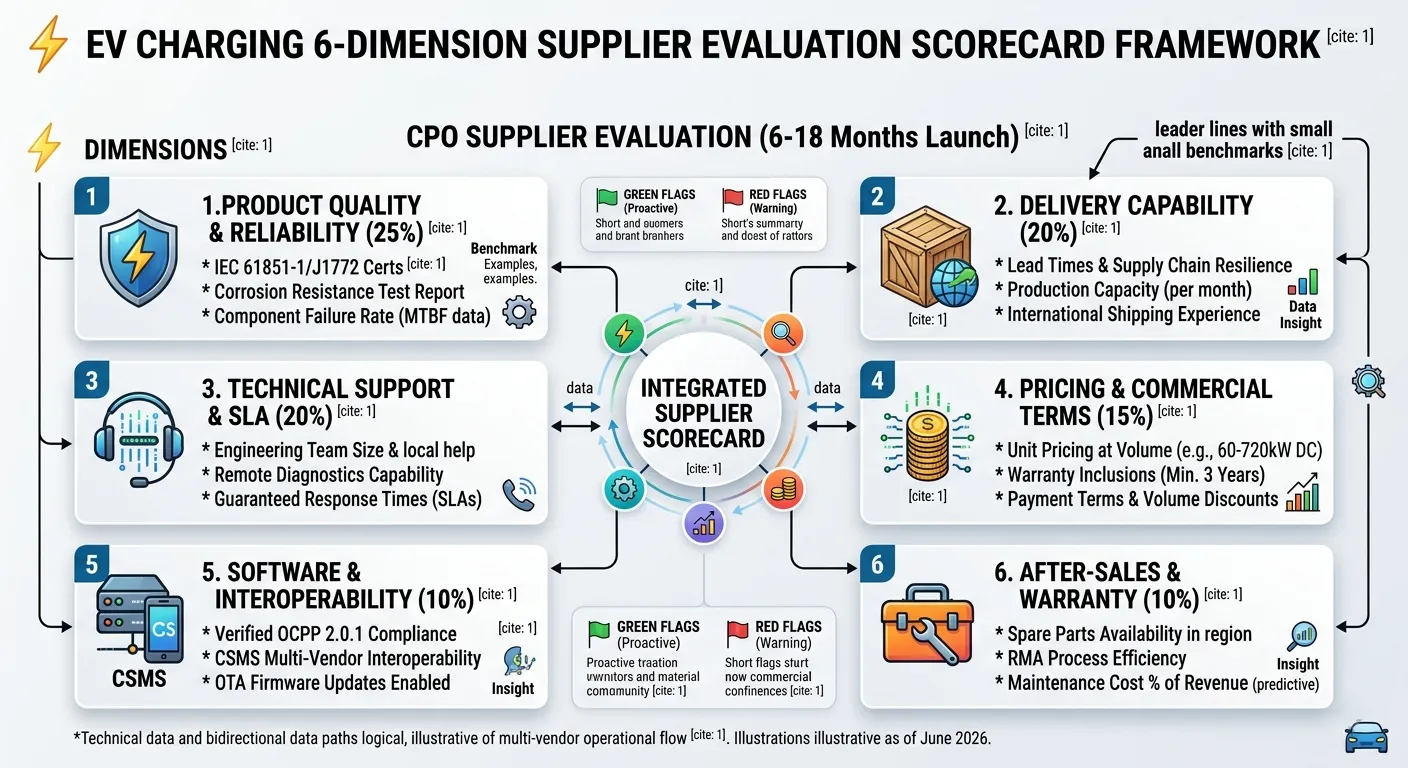
| Dimension | Weight | What to Evaluate |
|---|---|---|
| Product quality and reliability | 25% | Certifications (CE, UL, IEC 61851), field failure rate data, MTBF for power modules, corrosion resistance, IP rating test reports |
| Delivery capability | 20% | Production capacity, lead times, supply chain resilience, international shipping experience, packaging standards |
| Technical support and SLA | 20% | Engineering team size, remote diagnostics capability, field service availability, guaranteed response times |
| Pricing and commercial terms | 15% | Unit pricing at volume, payment terms, warranty inclusions, spare parts pricing transparency |
| Software and interoperability | 10% | Verified OCPP 2.0.1 compliance (Hubject or Keysight certified), CSMS compatibility, OTA firmware updates |
| After-sales and warranty | 10% | Minimum 3-year warranty, spare parts availability in target market, RMA process efficiency |
Green flags during supplier evaluation: OCPP compliance independently verified, field failure rate data shared proactively, factory audit welcomed, reference CPO customers with 12+ months of operational data, and spare parts stocked in your region.
Red flags: Certifications not traceable to a named test laboratory, factory audit refused, no OCPP live demonstration available, warranty that excludes power modules, and no reference customers with deployed fleets of 50+ units.
Matching Hardware to Use Case
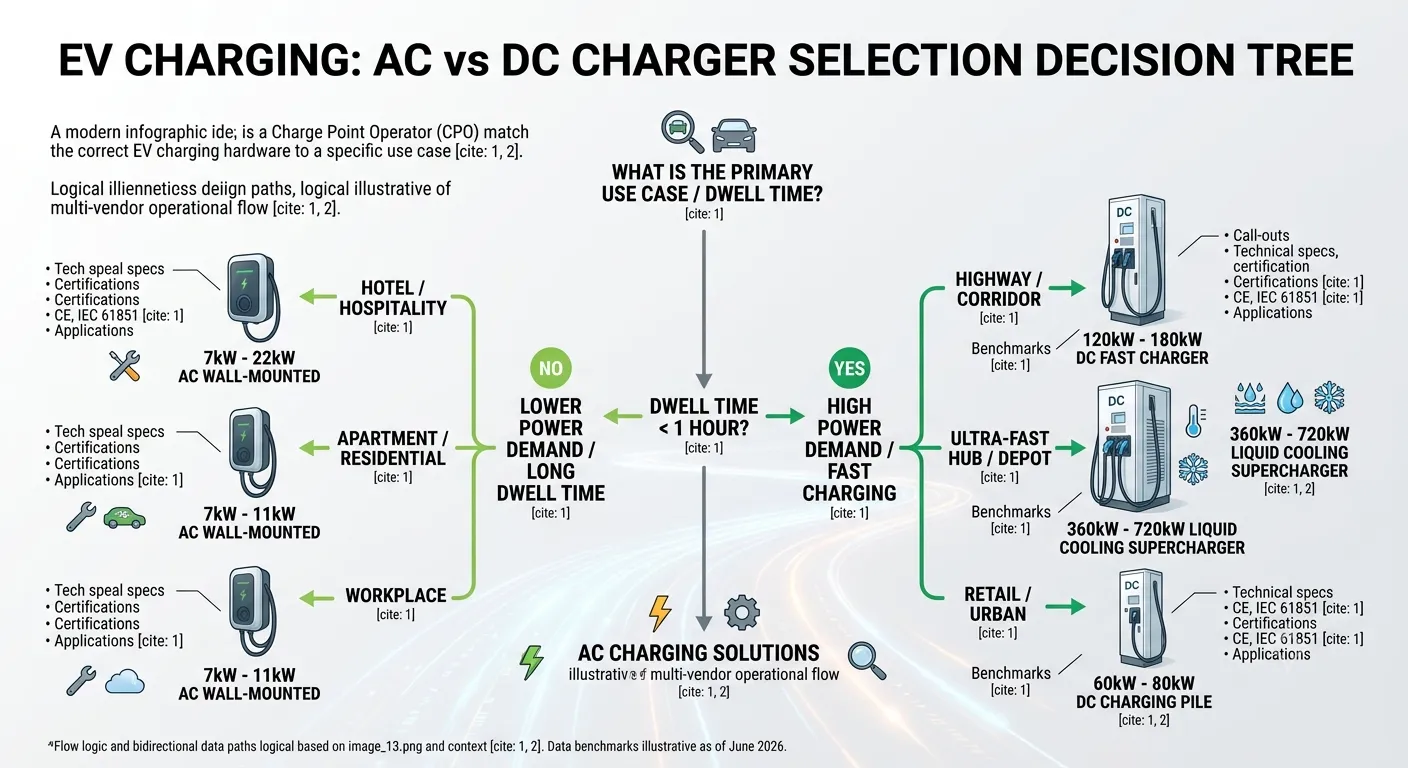
Not every charger fits every site. Matching power level to dwell time is the core of CPO hardware planning:
| Power Level | Best Use Case | Typical Dwell Time | Klitv Solution |
|---|---|---|---|
| 7kW – 22kW AC | Apartments, workplaces, hotels, long-stay parking | 4–10 hours | 7kW wall-mounted AC with 2.0mm steel body |
| 60kW – 80kW DC | Retail centers, urban parking, medium-turnover sites | 45–90 minutes | 60-80kW DC charging pile, OCPP-compliant |
| 120kW – 180kW DC | Highway corridors, fuel station replacements, fleet depots | 20–40 minutes | 120-180kW DC fast charger, dual CCS2 |
| 360kW – 720kW DC | Megawatt charging hubs, truck and bus depots | 10–30 minutes | 360-720kW liquid cooling supercharger |
The OCPP Imperative
OCPP (Open Charge Point Protocol) is the communication standard that allows your chargers to talk to your backend system. For CPOs, OCPP compliance is not optional. It is the foundation of operational flexibility. Without it, you are locked into a single software vendor. With it, you can switch CMS providers, integrate with roaming platforms, and adopt new smart-charging capabilities as they emerge.
OCPP 2.0.1 is the current recommended standard. It supports ISO 15118 Plug & Charge, enhanced security via TLS 1.3, and advanced smart-charging profiles for dynamic load management and V2G applications. When evaluating hardware, ask the manufacturer to demonstrate OCPP 2.0.1 connectivity live, not just provide a compliance document.
For a deeper technical explanation, read our complete guide to OCPP.
Why Hardware Build Quality Determines CPO Profitability
Low-quality chargers typically cost 20 to 30 percent less upfront. Over a five-year operating period, they cost two to four times more. Here is why.
When a charger fails, the CPO loses more than the session. They lose driver trust. Fleet operators with guaranteed uptime clauses incur penalties. Support calls cost EUR 2 to 10 each. A technician dispatch can run EUR 200 to 500 per visit. If a charger sits broken for two weeks waiting for a replacement power module, the revenue loss compounds daily. So does the reputational damage.
Klitv chargers are built with a 2.0mm thickened steel body designed to withstand rain, snow, and outdoor conditions year after year. Every unit uses high-precision parts with no recycled materials. Each charger undergoes rigorous quality inspection at our 20,000 square meter factory before shipping. These are not marketing claims. They are engineering decisions that directly determine whether a charger is still operating reliably in year five.
The team at a logistics depot in Thailand learned this firsthand. They deployed a mixed fleet of chargers from two suppliers in early 2024. Over 18 months, they tracked failure rates across 22 units. The chargers from the lower-cost supplier experienced power module failures at 3.5 times the rate of the higher-quality units. Each failure meant 5 to 9 days of downtime waiting for parts. By the end of year one, the savings from the lower purchase price were completely consumed by lost revenue and emergency maintenance costs.
Global Deployment: Packaging, Logistics, and Certification
For CPOs operating across multiple countries, hardware logistics are a major operational consideration. A charger that leaves the factory in perfect condition but arrives at the project site with shipping damage creates weeks of delay, not days.
Industrial-grade packaging matters more than most CPOs realize until they open their first shipment. Klitv uses custom wooden crates built for long-distance container shipping. Each unit is inspected and secured before dispatch. This ensures your chargers arrive in the same condition they left the factory, whether the destination is a highway rest stop in Germany, a fleet depot in Ghana, or a hotel parking structure in Dubai.
Multi-region certification is equally important. Verify that your manufacturer holds certifications applicable to your target markets: CE and IEC 61851 for Europe, UL 2594 and UL 2202 for North America, and relevant local certifications for other regions. A manufacturer with existing certifications across multiple markets saves CPOs months of compliance work.
For more on global charger deployment, see our commercial EV charger guide.
CPO Profitability: Revenue Models, Costs, and Financial Planning
How Charge Point Operators Generate Revenue
CPO revenue comes from multiple streams. The most profitable operators combine several:
| Revenue Stream | Description | Typical Contribution |
|---|---|---|
| kWh-based billing | Per-unit energy pricing (most common model) | 50–70% of revenue |
| Time-based billing | Per-minute pricing, common at DC fast chargers | 10–20% |
| Session and idle fees | Fixed per-session charges plus fees for occupying a charger after completion | 5–10% |
| Subscription and membership plans | Monthly recurring revenue from frequent users | 5–15% |
| Fleet contracts | Negotiated rates for guaranteed-volume commercial customers | Variable; high-margin |
| Roaming revenue | Income from drivers using other eMSPs to access your chargers via OCPI | 5–10% |
| Carbon credits | Monetizing the environmental value of dispensed clean energy | Emerging; 2–8% |
| Grid services | Demand response, frequency regulation, and V2G participation | Early stage; growing |
KPIs That Matter for CPO Profitability
Traditional metrics like utilization rate are useful but incomplete. The industry is shifting toward profit-per-kWh as the primary KPI. High utilization paired with unfavorable demand charges can still result in negative margins.
Key profitability metrics to track:
- Gross margin per kWh: after electricity costs and demand charges
- Revenue per charger per day: combines utilization, pricing, and session patterns
- Maintenance cost as percentage of revenue: target below 10%
- Session success rate: every failed session is direct revenue loss
- Customer acquisition cost vs. lifetime value: especially for subscription models
The Hidden Cost Most CPOs Underestimate
Payment processing fees, roaming partner margins, and currency conversion costs scale directly with transaction volume. For a mid-sized CPO processing 50,000 sessions per month, this can reach EUR 300,000 or more annually. This cost grows linearly with success. Negotiate payment processing rates and roaming agreements carefully. Include these costs in your pricing model from the start.
Use Klitv’s EV charging ROI calculator to model hardware costs, projected utilization, energy pricing, and payback periods for your specific project.
CPO Challenges in 2026 and Practical Solutions
Grid Connection Delays
Grid interconnection has become the single biggest bottleneck in CPO project timelines. Lead times stretch to 24 months in many regions. Effective mitigation strategies include co-locating battery storage to reduce peak demand on the grid connection, deploying dynamic load management to maximize throughput from a given connection, and filing interconnection applications before finalizing site leases.
Hardware Reliability and Maintenance
Even as overall charger reliability improves, the cost of downtime is increasing because driver expectations are rising. Predictive maintenance, using OCPP data patterns to identify degrading components before they fail, is becoming an operational necessity. The quality of the hardware you install determines how much maintenance you need to do. Investing in proven build quality upfront reduces the maintenance burden for years.
Regulatory Complexity Across Markets
CPOs operating in multiple countries face different reporting formats, certification requirements, and payment mandates. Standardizing on OCPP 2.0.1 hardware from a manufacturer with multi-region certification experience simplifies the compliance burden from the start.
Driver Experience and Payment Friction
The J. D. Power finding bears repeating: even as reliability improves, satisfaction is declining because of payment complexity. CPOs who offer straightforward, transparent pricing with multiple payment options will differentiate themselves in an increasingly crowded market. Contactless card, app, RFID, and Plug & Charge should all be supported.
Building a Charge Point Operator Network That Lasts
The CPO market in 2026 comes down to a single truth: charging hardware is not a commodity. Every decision about build quality, OCPP compliance, manufacturer support, and global logistics compounds across years of operation. Those decisions either build a reliable revenue stream or create a growing maintenance liability.
The most successful charge point operators share a common approach. They evaluate hardware manufacturers as long-term partners, not transactional suppliers. They demand evidence of build quality: material specifications, certification test reports, field failure rate data. They choose chargers engineered for the conditions they will actually face: rain, temperature extremes, continuous use, and the occasional driver who treats a charging cable with less care than it deserves.
Klitv delivers EV charging solutions through Zhengzhou Klitv Equipment Co., Ltd., established in 2020 with full independent export qualifications. Our chargers span 7kW AC wall-mounted units to 720kW liquid-cooled DC superchargers. All feature 2.0mm thickened steel enclosures, high-precision components with no recycled materials, and rigorous quality inspection at every stage. Every unit is packed in industrial-grade wooden crates for safe delivery to your project site, whether that is a highway corridor in Germany, a fleet depot in Southeast Asia, or a commercial parking facility in the Middle East. With over 800 engineers providing online and offline technical support, you have a partner who stays with you long after the chargers are installed.
The charge point operator who gets hardware right from the start builds a network that earns driver loyalty, achieves profitable utilization, and scales without compounding maintenance costs. The operator who treats hardware as an afterthought spends years paying for that decision, one failed session at a time.
Ready to build a charging network on reliable hardware? Contact the Klitv engineering team to discuss your CPO project requirements, request technical specifications, or arrange a factory audit.